Annex 1 explained: What it means and our compliant solutions
Watch "Annex 1 explained: What it means and our compliant solutions" on YouTube 
Annex 1 of the EU‑GMP guidelines defines the globally relevant standard for the manufacture of sterile pharmaceutical products. It applies to all companies producing sterile products for the European market – regardless of their location – and sets the highest expectations for processes, equipment, and technologies.
The version in force since August 2023 raises the bar even further: it focuses on contamination‑controlled manufacturing environments, a holistic Contamination Control Strategy (CCS), and more detailed requirements for aseptic processing, automation, sterilization technologies, and process monitoring. The goal is to ensure that sterile products are manufactured at all times under controlled, reproducible, and safe conditions.
As a solution provider for high‑quality filling and closing systems, we develop technologies that are fully aligned with these requirements. Through intelligent automation, thoughtful design, and technical precision, we combine regulatory compliance with economic efficiency. This results in future‑proof solutions that meet current Annex‑1 expectations and support pharmaceutical manufacturers long‑term in quality, compliance, and innovation.
Annex 1 of the EU‑GMP guidelines defines the globally relevant standard for the manufacture of sterile pharmaceutical products. It applies to all companies producing sterile products for the European market – regardless of their location – and sets the highest expectations for processes, equipment, and technologies.
The version in force since August 2023 raises the bar even further: it focuses on contamination‑controlled manufacturing environments, a holistic Contamination Control Strategy (CCS), and more detailed requirements for aseptic processing, automation, sterilization technologies, and process monitoring. The goal is to ensure that sterile products are manufactured at all times under controlled, reproducible, and safe conditions.
As a solution provider for high‑quality filling and closing systems, we develop technologies that are fully aligned with these requirements. Through intelligent automation, thoughtful design, and technical precision, we combine regulatory compliance with economic efficiency. This results in future‑proof solutions that meet current Annex‑1 expectations and support pharmaceutical manufacturers long‑term in quality, compliance, and innovation.

Annex 1: Requirements and relevance for Bausch+Ströbel
Annex 1 of the EU‑GMP guidelines defines stringent requirements that affect all aspects of sterile manufacturing – from cleanroom technology and process automation to personnel qualification.
Within the GMP framework, the Pharmaceutical Quality System (PQS) serves as the overarching quality management system that structures and controls the planning, execution, and continuous monitoring of all activities required to maintain product quality. In the context of Annex 1, this means above all that sterility must be achieved and consistently maintained in all critical areas.
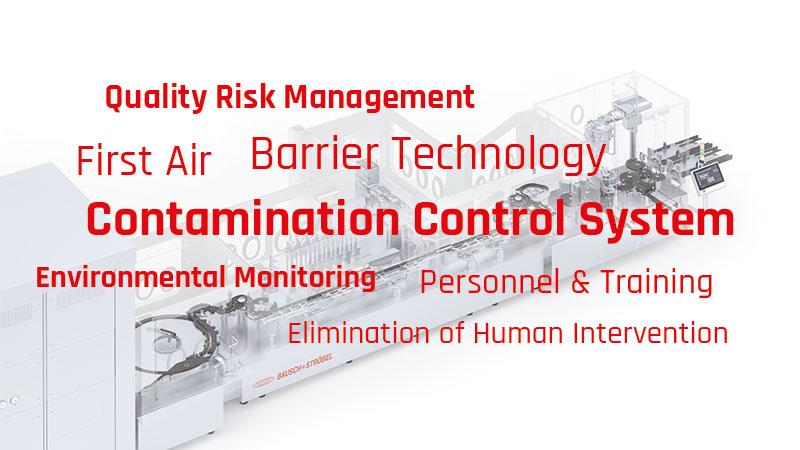
The focus lies on clearly defined processes, risk management (QRM), and documented contamination control measures captured within the Contamination Control Strategy (CCS).
As an integral part of the PQS, QRM provides structured methodologies for risk assessment, enabling potential risks across all process steps to be identified, evaluated, minimized, eliminated, or controlled at an early stage.
These resulting measures are consolidated within the CCS. To maintain sterility in critical zones, this includes reducing manual interventions through automation, as well as implementing barrier technologies such as RABS and isolators. Optimizing airflow – ensuring unobstructed First Air – is another highly effective protective mechanism against airborne contamination (microbial or particulate) in critical areas. Remaining residual risks are continuously monitored through a comprehensive Environmental Monitoring (EM) program.
Personnel & Training represents another essential pillar: only well‑trained, competent personnel can reliably fulfill the high expectations of Annex 1. Regular training, competency assessments, and a strong awareness of process and contamination control are indispensable.
Taken together, these requirements form a holistic system of safety and quality that enables modern pharmaceutical manufacturing to operate efficiently, safely, and in full regulatory compliance. Our filling and closing systems are designed precisely to meet these Annex‑1 expectations – delivering maximum safety, minimal risk, and the highest product quality.
An effective Contamination Control Strategy (CCS) according to Annex 1 requires a holistic and integrated approach to preventing microbial and particulate contamination in sterile manufacturing processes. It includes clearly defined cleanroom classifications, controlled airflow concepts, personnel and material flow management, continuous environmental and process monitoring programs, as well as validated cleaning, disinfection, and sterilization procedures. The objective is to ensure product integrity – and therefore patient safety – at all times. The CCS must be fully documented, continuously monitored, and adapted to process changes to ensure that sterile manufacturing operations remain reproducible, reliable, and compliant with the latest regulatory expectations.
Quality Risk Management (QRM) according to Annex 1 requires a systematic and fully documented risk assessment of all sterile manufacturing processes. The aim is to identify, evaluate, and proactively minimize potential contamination and safety risks before they can impact product quality. This includes the analysis of equipment, procedures, materials, and personnel interactions, as well as the definition of appropriate control and prevention measures.
QRM must be continuously monitored, adjusted, and integrated into operational decision‑making to ensure that all processes remain reproducible, safe, and fully compliant with regulatory expectations.
QRM must be continuously monitored, adjusted, and integrated into operational decision‑making to ensure that all processes remain reproducible, safe, and fully compliant with regulatory expectations.
First Air is a central principle of Annex 1 for contamination control in sterile manufacturing processes. It refers to the direct, unobstructed airflow from the HEPA filter to critical product and process areas, ensuring that potential contamination risks are effectively minimized.
Key requirements include correct airflow direction and velocity, maintaining unobstructed airflow paths without turbulence, and continuous monitoring of air quality. First Air must reach the critical point at all times without contacting any surfaces, ensuring reliable product sterility and protecting the integrity of the sterile process.
Key requirements include correct airflow direction and velocity, maintaining unobstructed airflow paths without turbulence, and continuous monitoring of air quality. First Air must reach the critical point at all times without contacting any surfaces, ensuring reliable product sterility and protecting the integrity of the sterile process.
Barrier technologies are a key element of Annex 1 for minimizing contamination risks in sterile processes. They include physical separation systems such as RABS (Restricted Access Barrier Systems) and isolators, which create a defined barrier between the product and operating personnel during the filling process.
Requirements include controlled airflow from areas of higher to lower cleanliness levels, validated decontamination and disinfection processes, automated material and personnel interactions, and continuous monitoring of barrier performance.
The objective is to reliably ensure product sterility by consistently applying the first‑air principle within the barrier system - providing unobstructed, contamination‑free air to all critical zones throughout the sterile process.
Requirements include controlled airflow from areas of higher to lower cleanliness levels, validated decontamination and disinfection processes, automated material and personnel interactions, and continuous monitoring of barrier performance.
The objective is to reliably ensure product sterility by consistently applying the first‑air principle within the barrier system - providing unobstructed, contamination‑free air to all critical zones throughout the sterile process.
Environmental Monitoring (EM) according to Annex 1 is a central element of the Contamination Control Strategy. It enables the continuous surveillance of sterile manufacturing environments and minimizes the risk of microbial and particulate contamination.
Typically, EM includes:
Typically, EM includes:
- Environmental monitoring for total particles
- Environmental and personnel monitoring for viable particles
- Monitoring of temperature, humidity, and other critical parameters
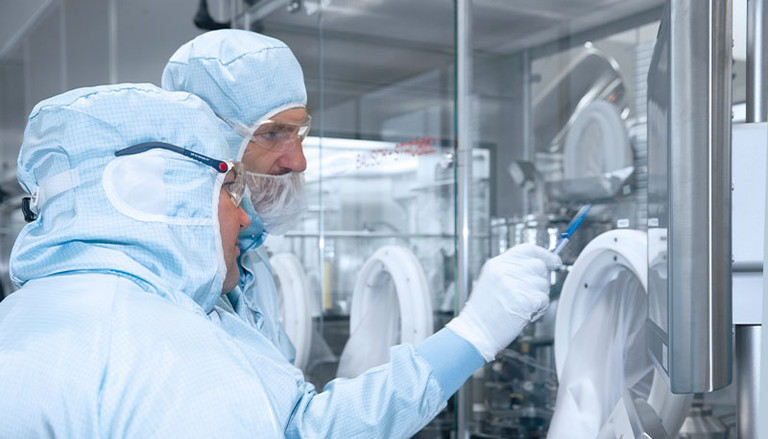
Personnel and training according to Annex 1 are essential for effective contamination control in sterile manufacturing environments. All personnel must be comprehensively trained and qualified for their specific tasks, be familiar with the applicable SOPs (Standard Operating Procedures), and receive regular training updates. Requirements include ongoing training programs, competency assessments, thorough documentation of all training activities, and fostering a strong awareness of sterility, contamination control, and quality responsibility.
Only qualified personnel who consistently follow the required behaviors and process steps can ensure that sterile products are manufactured safely and reproducibly.
Only qualified personnel who consistently follow the required behaviors and process steps can ensure that sterile products are manufactured safely and reproducibly.
The elimination of human interaction is a core principle of Annex 1 to minimize contamination risks in sterile manufacturing processes. Direct contact by personnel in critical areas should be avoided as far as possible. This is achieved through automation and optimized process workflows. The objective is to reduce human error, safeguard sterility, and ensure process reproducibility. Every personnel intervention must be documented, validated, or controlled through appropriate technical measures.